


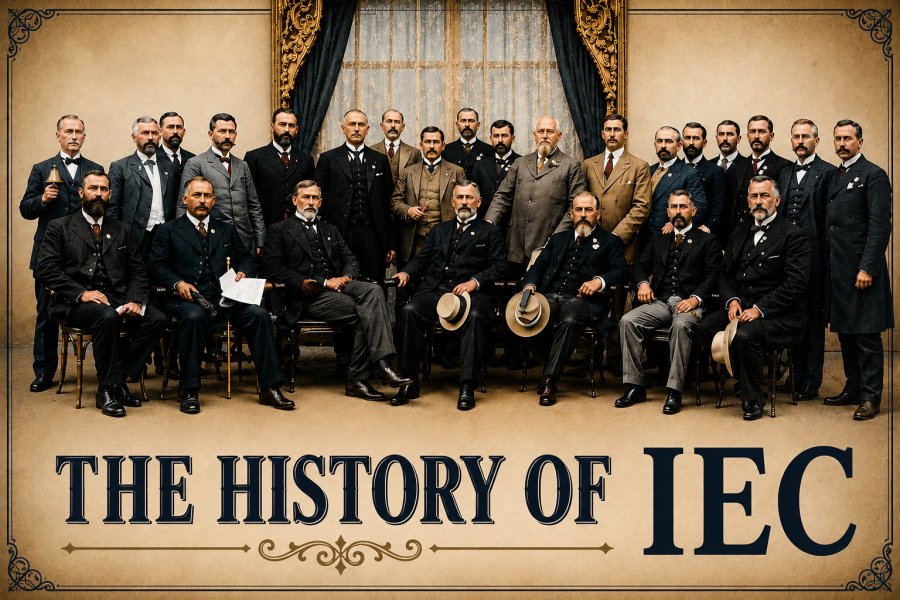
THE HISTORY OF IEC: HOW INTERNATIONAL ELECTROTECHNICAL STANDARDS WERE BORN
Introduction
Today, virtually every modern electrical product—from power transformers to lightning protection systems—is designed in accordance with international standards. The abbreviation IEC has become a global symbol of technical compatibility, safety, and unified requirements for electrical and electronic equipment. However, at the end of the 19th century, the situation was entirely different.
Different countries used their own measurement systems, testing methods, equipment requirements, and even technical terminology. This lack of uniformity complicated international trade, hindered the development of the power industry, and created challenges for engineers working across borders. The need for a common technical language ultimately led to the establishment of the world's first international organization dedicated to electrotechnical standardization—the International Electrotechnical Commission (IEC).
The Beginning of the Electrical Revolution
The Second Industrial Revolution of the late 19th century introduced electric lighting, electric motors, the telegraph, the telephone, and the first electric power networks.
Despite this rapid technological progress, development was far from uniform. Every manufacturer adopted its own design principles, voltage systems, testing procedures, and technical specifications.
Engineers increasingly encountered situations where equipment manufactured in one country could not be properly integrated with equipment produced in another. It became clear that the growing electrical industry required an international system of technical standardization.
The St. Louis Congress That Changed History
In 1904, during the International Electrical Congress held in St. Louis, the idea of establishing an international organization responsible for developing unified electrotechnical standards was officially proposed for the first time.
One of the principal advocates was British engineer Reginald Edward Bevan Crompton (R. E. B. Crompton). His proposal received broad support from engineering societies representing numerous countries and laid the foundation for the future International Electrotechnical Commission.
The Birth of IEC
On 26–27 June 1906, delegates from fourteen countries gathered in London for the inaugural meeting of the new organization.
Thus, the International Electrotechnical Commission (IEC) was officially established.
The first President of the Commission was the distinguished British physicist Lord Kelvin (William Thomson), whose name is immortalized in the Kelvin absolute temperature scale.
The First Objectives of IEC
During its early years, the Commission focused not on developing comprehensive standards, but on harmonizing the fundamental elements of electrical engineering, including:
- electrical terminology;
- units of measurement;
- technical symbols and designations;
- parameters of electrical machines;
- testing methods.
IEC played a significant role in the development of internationally accepted engineering terminology and contributed to the establishment of the modern International System of Units (SI).
From Standards to a Global Safety System
Over more than a century, the scope of IEC's activities has expanded dramatically.
Today, IEC develops international standards covering:
- electric power systems;
- electronics;
- renewable energy;
- medical electrical equipment;
- battery technologies;
- industrial automation;
- electric vehicles;
- electrical safety;
- lightning protection;
- grounding and earthing systems;
- surge protection.
Today, tens of thousands of experts from industry, academia, government institutions, and testing laboratories contribute to IEC's technical work. IEC standards are used directly or harmonized in more than 130 countries around the world.
IEC and Modern Lightning Protection
One of IEC's most significant achievements is the development of the IEC 62305 series, "Protection against Lightning."
This internationally recognized standard defines the fundamental principles for:
- lightning risk assessment;
- external lightning protection system design;
- grounding and earthing systems;
- equipotential bonding;
- Lightning Protection Zones (LPZ);
- protection of electrical and electronic equipment against lightning electromagnetic impulses and transient overvoltages.
The IEC 62305 series is regularly updated to reflect scientific advances and technological innovation, ensuring a consistently high level of protection for buildings, industrial facilities, and critical infrastructure.
The Importance of IEC for Ukrainian Industry
Ukraine's integration into the European technical community has been accompanied by the harmonization of national standards with international IEC standards and European EN standards.
For manufacturers, this means not only producing high-quality products but also demonstrating compliance with internationally recognized requirements for safety, reliability, and long-term performance.
As a result, Ukrainian companies operating in the fields of lightning protection and grounding are increasingly incorporating IEC requirements into product development, material selection, testing procedures, and manufacturing processes.
One example is ENEL Ukraine, a manufacturer of lightning protection and grounding systems that continuously adapts its products and technical documentation in accordance with modern IEC standards and harmonized European regulations. This approach enhances product compatibility with contemporary engineering practices while meeting the expectations of designers, installers, and infrastructure developers working under international standards.
Conclusions
The history of IEC is the story of how international engineering cooperation became the foundation of modern electrical engineering. Established in 1906 to unify technical terminology and engineering practices, IEC has evolved into the world's leading organization for developing international electrotechnical standards.
For the fields of lightning protection and grounding, IEC standards serve not only as the technical basis for system design but also as an essential tool for improving safety, reliability, and long-term operational performance. Consequently, manufacturers that align their products with IEC requirements contribute to the advancement of modern electrical engineering while strengthening the global competitiveness of their technologies and supporting the integration of Ukrainian industry into the international market.